



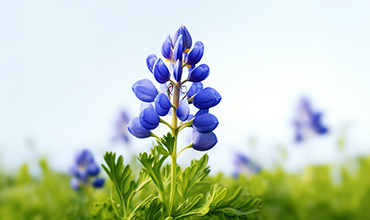
When our family moved to Texas in late August 2015, the landscape did not exactly win us over. The grass was faded from the summer heat, the trees looked tired, and the air felt heavy enough to wear. If it were possible to water plants with perspiration, we would have kept the whole neighborhood green.
A friend tried to help us see what we were missing. She spoke about bluebonnets with the kind of reverence usually reserved for holidays or long-held family traditions.
“Just wait,” she said. “In the spring, everything turns blue.”
At the time, it was hard to imagine. We scanned roadsides and parks for signs of this promised transformation, but in August, bluebonnets were nowhere to be found. The only ones we saw were printed on candles and dish towels at the grocery store.
Then spring arrived.
On one of those perfect days, with clear skies and a soft breeze, we went for a walk. That was when we spotted our first bluebonnet. It was small, tucked low in the grass, easy to miss if you were not looking carefully.
It did not look like much, certainly not like the sweeping fields we had heard about.
At first, we were underwhelmed. But what we did not yet realize, what every longtime Austin family already knows, is that bluebonnets are not meant to be admired one at a time. They are meant to be experienced together.
A Flower with Deep Texas Roots
Bluebonnets, part of the lupine family and known scientifically as Lupinus texensis, became the official state flower of Texas in 1901. The decision followed a lively debate among lawmakers, botanists, and women’s groups advocating for different native plants. In the end, the bluebonnet was chosen for its resilience, beauty, and deep connection to the Texas landscape.
These wildflowers thrive in the limestone-rich, well-drained soils common around Austin and the Hill Country. Their seeds germinate in the fall, grow slowly through winter, and bloom in early spring, typically March and April. When conditions align, especially after a rainy fall and mild winter, the results can be spectacular.
Some years, the fields seem endless. Other years, they are more modest, reminding families that bluebonnet season is never guaranteed and always worth appreciating.
Why Austin Turns Blue
Bluebonnets are not just a happy accident of nature. Their abundance is also the result of decades of stewardship.
Since the 1930s, the Texas Department of Transportation has planted and maintained wildflower seeds along highways and public lands. This effort, supported by Lady Bird Johnson’s environmental work, helped transform ordinary roadsides into seasonal showcases.
Around Austin, bluebonnets appear along Loop 360, MoPac, neighborhood parks, greenbelts, and open fields. Many families also head west, where displays can be more dramatic.
Areas along Highway 290 toward Fredericksburg and the Willow City Loop are known for sweeping views. Closer to home, even a small patch near a sidewalk can become the backdrop for a meaningful family moment.
The Family Tradition
At some point, without much planning, we became one of those families.
The kind that watches for the first blooms of the season. The kind that slows down while driving to check if a field has reached its peak. The kind that packs up the kids, a camera, and a change of clothes, just in case.
Austin bluebonnet photos are not optional; they are a rite of passage.
Every spring, families step into fields of blue to capture that perfect picture. Toddlers sit cautiously among the flowers. Older kids strike playful poses. Parents crouch low, adjusting angles and lighting.
It does not have to be a sprawling field. Sometimes it is a small patch near a curb, carefully framed to look much bigger.
But when it comes together, it feels like more than a photo.
It feels like belonging.
There is an unspoken understanding here: you know you are a true Texan when your family has a bluebonnet photo.
Festivals, Fun, and Community
Bluebonnet season is also a time for celebration.
Communities across Central Texas host festivals featuring live music, food vendors, crafts, and activities for kids. Nearby towns embrace the season with parades, wildflower drives, and photo contests that invite families to share their favorite snapshots.
For many, entering a child’s bluebonnet photo into a local contest is just as much a tradition as taking the photo itself.
Even in Austin, the excitement is easy to feel. Social media fills with vibrant blue backdrops, and families share tips on the best spots.
A Few Tips for Families
As inviting as those fields may be, there are a few important guidelines to keep in mind.
Be mindful of where you step. While bluebonnets are hardy, the ecosystems around them are delicate. Stick to open areas when possible and avoid trampling large patches.
Resist the urge to pick the flowers. While it is not illegal in most cases, it is strongly discouraged, especially on public land.
Also consider safety. Fire ants, bees, and occasionally snakes can be present. Closed-toe shoes, awareness, and a quick scan of the ground help keep everyone safe.
A blanket, wipes, and snacks can also make the outing more enjoyable.
Why It Matters
At first, we thought bluebonnets were just flowers.
We were wrong.
Bluebonnets are a signal. They mark the shift from winter to spring. They invite families outdoors and create a shared experience across communities.
They also remind us to slow down. Because the season is short.
In just a few weeks, the fields fade, the petals drop, and the moment passes. But while they are here, they offer a reason to pause, gather, and take it all in.
Falling in Love with Austin
Looking back, it is easy to see how it happened.
What started as curiosity became tradition. What felt unfamiliar became something we look forward to every year.
Bluebonnets did not impress us all at once. They grew on us, quietly, until one day we could not imagine spring without them.
Now, when the first blooms appear, we know exactly what to do.
We grab the kids. We pack the camera. We head out in search of that perfect patch of blue.
Because in Texas, bluebonnet season is not just something you see.
It is something your family lives.
And once you do, you understand why it matters so much.
Kimmi Falconer is married to David and mom to four daughters, one in heaven. Based in Texas, she shares joy, color, and helps others live their joy life as a podcaster. Follow her @LivingYourJoyLife. Listen on Spotify @LivingyourJOYlife.