





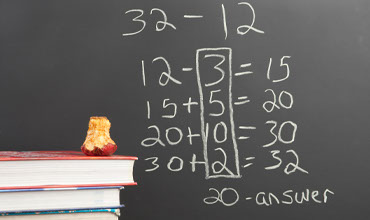
Math homework coming home from elementary school today often uses methods that didn’t exist when most parents were in school. A second grader might be asked to break 47 into 40 and 7 before adding another number, instead of stacking digits and carrying a one. Parents who learned one fast way to get the answer can watch their child solve the same problem correctly using a method that looks unfamiliar, and the instinct to jump in and teach “the real way” often makes homework time harder instead of easier.
None of this happened by accident, and no single teacher decided to try it on their own. The shift traces back to decisions made well above the classroom, about which strategies get taught first and using which materials, and knowing where those decisions come from changes how a parent can help without turning homework into a fight over whose method is correct.
Who Actually Decides the Sequence
A classroom teacher doesn’t sit down and invent this sequence for their own students. Texas school districts choose from a set of state-approved math curricula, and that choice usually comes out of a math committee made up of curriculum specialists, instructional coaches and campus administrators who spend months comparing several programs before recommending one to the district. That process has played out in districts across the Austin area recently, weighing state-developed materials against other approved programs before settling on what teachers will actually use the following year.
People filling curriculum specialist and instructional coach roles typically taught in a classroom first, then moved into work that’s less about one classroom and more about how an entire district sequences and evaluates instruction across every grade level. An online EdD curriculum and instruction is the credential a lot of them hold, since that degree focuses specifically on how instructional materials and learning sequences get designed, tested and judged, which is a different body of knowledge than a teaching certificate covers on its own. That’s also why the person who could explain why a district switched math programs usually isn’t the classroom teacher who sent the worksheet home.
The Actual Difference Isn’t the Math, It’s the Method
Addition, subtraction and multiplication haven’t changed. What changed is the expectation that a child understands why a method works before locking into one fast way to do it every time. Current standards ask students to explain their thinking and try more than one strategy on the same problem, rather than memorize a single procedure and repeat it, a reasoning-first approach that education researchers who study how children learn math point to as the reason today’s worksheets look unfamiliar to parents. Wrestling with a concept before mastering a shortcut now counts as part of learning rather than something to rush past. A child who struggles briefly with a new strategy isn’t behind. Struggling with an idea long enough to make real sense of it is generally the point, even on problems that look almost too simple to deserve that much attention.
What Today’s Strategies Actually Look Like
Breaking numbers into parts: Instead of stacking two numbers and carrying digits right away, students split each number into hundreds, tens and ones, add the pieces separately, then combine the totals, which shows why carrying works instead of treating it as a rule to memorize without asking why.
Number lines and jumps: Rather than reaching straight for a written algorithm, a child might count up or back in chunks of ten and then ones along a number line, a method that mirrors how most adults actually do quick mental math without realizing it.
Grids for multiplication: Multiplying larger numbers gets broken into a grid of smaller, easier products that get added together at the end, which previews the exact logic behind the standard algorithm most children learn a year or two later, once the number sense underneath it is solid.
What Actually Helps at the Kitchen Table
Relearning every method a child brings home isn’t necessary and usually isn’t realistic on a weeknight. Asking a child to explain their thinking out loud, checking the curriculum notes or example problems that came home with the assignment, and resisting the urge to substitute a faster method from decades ago all do more good than re-teaching the page from scratch. A child who can explain a slower method they understand is further along than one who can only repeat a fast method they were shown but can’t explain. The goal was never to make homework harder to help with. It was to make sure a child understands the math well enough that the method barely matters by the time a worksheet isn’t sitting in front of them anymore.