





Managing schedules, money, time, and responsibilities is part of building a healthy life, yet these skills are not always included in conversations about children’s health. We teach children to eat well, exercise, get enough sleep, and visit the doctor, but there is another important piece of the puzzle: learning how to organize daily life so those healthy choices have a place to happen. These lessons can begin much earlier than many parents realize.
The First Lessons Are Routines
A toddler obviously doesn’t need a digital calendar, but a toddler can learn that breakfast happens before school, toys get picked up before bedtime, and tomorrow is coming whether we are ready for it or not. Those ordinary routines are the first lessons in time management and, in many ways, healthy living.
Children learn that sleep matters because bedtime comes every night. They learn that meals happen at regular times, that getting ready takes preparation, and that responsibilities are part of being a member of a family.
As children get older, parents can make the invisible parts of family life visible. When a doctor’s appointment goes on the calendar, let children see it happen. When planning a vacation, talk about the dates, what needs to be packed, and what needs to be completed before leaving. When a school project is due Friday, talk about why waiting until Thursday night may not be the best strategy. The lesson isn’t really about calendars. It’s about learning to look ahead, prepare, and make room for what matters.
Elementary School: Learning That Time Is a Resource
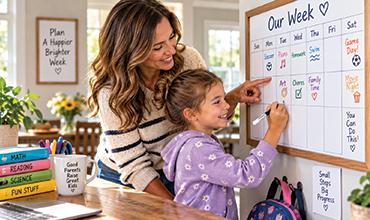
Elementary school is when children can begin moving from simply following routines to understanding how a schedule works. A family calendar can become surprisingly powerful. Put school events, sports practices, doctor’s appointments, birthdays, holidays, vacations, and other commitments where everyone can see them, and let children participate.
A child who knows there is a soccer game Saturday morning can learn that Friday night is a good time to find the uniform and shoes. A child with a book report due Friday can learn to break the assignment into smaller pieces rather than treating Friday as the only important date. That is more than organization. It is learning that time is a resource. How we use those 24 hours affects our stress, sleep, relationships, responsibilities, and health. That is a lesson in independence, reliability, and self-care.
The same thinking can apply to money. A child who receives an allowance can learn that money, like time, is a limited resource. Saving a portion, planning a purchase, and understanding that we cannot spend the same dollar twice are simple lessons in planning and delayed gratification. These early habits help children understand that healthy choices often involve thinking ahead.
Middle School: Learning to Balance Life
Middle school is when schedules often become more complicated. There are more assignments, activities, social commitments, and independence. This is also when parents can begin moving from being the family scheduler to being the family scheduling coach.
That transition can be uncomfortable. It is usually faster to make the appointment ourselves, remind the child about the assignment, or tell them exactly when to do something. But if we always do those things, our children may become very good at following instructions without becoming very good at managing themselves. Let them practice.
Have them enter their own assignments and activities into a calendar. Let them know when a doctor’s appointment is coming up and expect them to remember it. Encourage them to look at the week ahead before making another commitment. Let them help plan family activities and vacations, too. Ask what needs to happen before everyone leaves, what can be done ahead of time, and where there may be conflicts. These are small opportunities to practice decision-making while parents are still close enough to help.
Middle school is also an important time to introduce balance. A healthy schedule is not one packed from morning until night. Children need sleep, nutritious meals, exercise, family time, friendships, schoolwork, recreation, and unstructured downtime. Learning to recognize when the calendar is too full is itself a health skill. Sometimes the healthiest choice is to say no.
The Family Calendar Is a Health Tool
A family calendar is more than a place to record appointments. It can teach communication, preparation, responsibility, and cooperation. The technology matters less than the habit. A phone, computer, wall calendar, or paper planner can all work. The important part is making plans visible and giving children opportunities to participate. When possible, coordinate appointments and activities, plan vacations far enough ahead to prepare, and look at the coming week before it arrives. At the same time, leave some white space. Every square does not need to be filled. Kids need downtime, and families need time for rest, conversation, play, and unplanned moments.
No matter how carefully we plan, schedules will change. Appointments get canceled, plans shift, homework takes longer than expected, and someone forgets something important. Learning to adjust is just as important as learning to plan. The goal isn’t to raise kids with perfectly organized calendars. It is to help children understand that managing their time is connected to caring for themselves and others. Start small, let young children learn routines, involve elementary school children in the family calendar, and gradually give middle schoolers more responsibility for their own commitments. Scheduling is about more than getting somewhere on time. It is about making room for what matters and building healthy habits through everyday choices about sleep, food, exercise, responsibilities, relationships, stress, work, and rest.
Anton Edward Cox is a nutritionist, husband, and father of 6. He’s passionate about illness prevention with an aim to empower parents to build strong, healthy families.